



Revolutionizing Public Safety: The State Police AI Reference Architecture
Introduction
In an era where digital threats and public safety challenges evolve rapidly, modern law enforcement agencies can no longer rely on legacy systems alone. To stay ahead, state police and public safety organizations are turning to next-generation technologies.
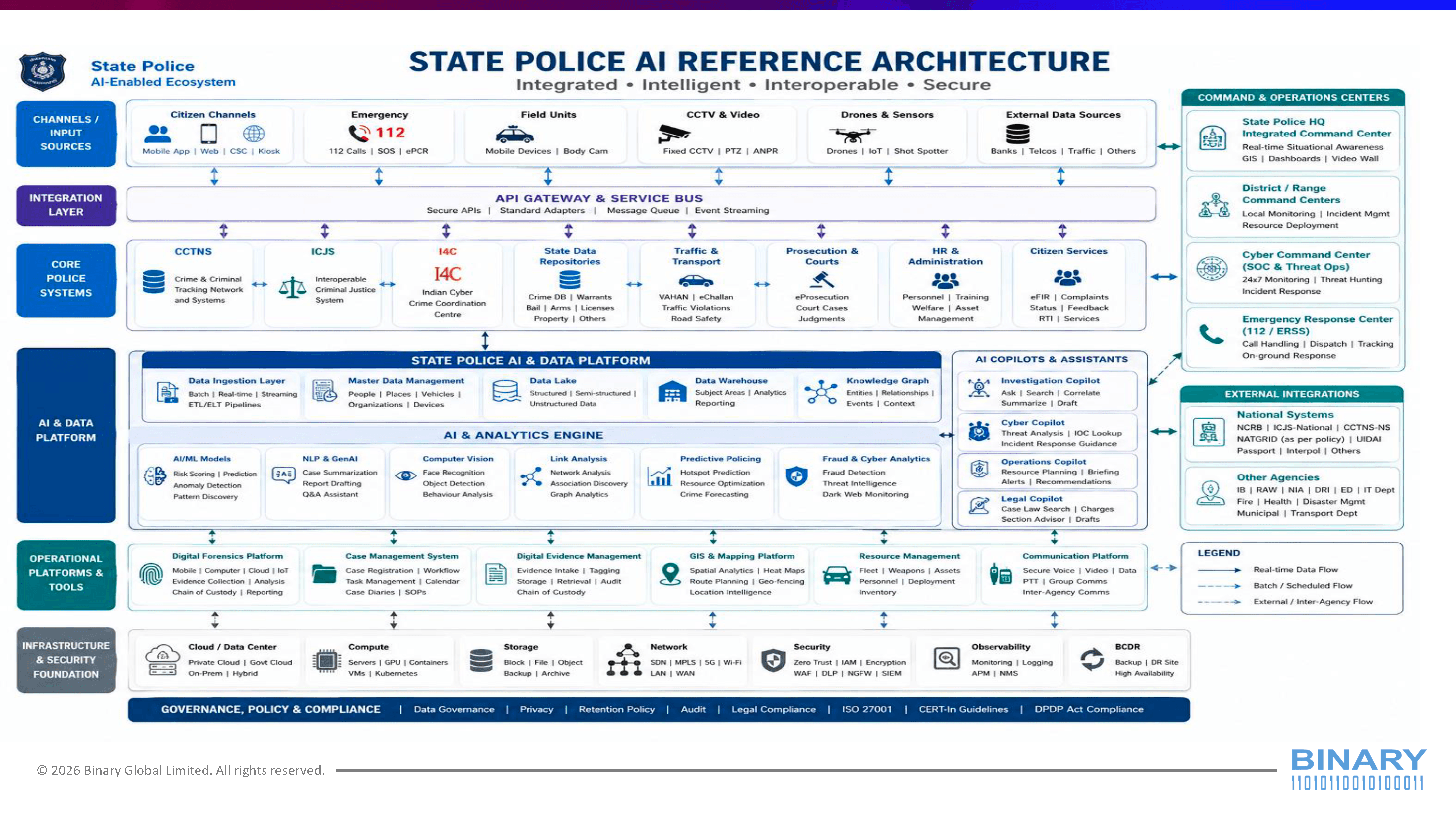
The State Police AI Reference Architecture represents a paradigm shift moving agencies toward an ecosystem that is Integrated, Intelligent, Interoperable, and Secure.
In this blog post, we break down how this comprehensive framework empowers law enforcement agencies to harness Artificial Intelligence (AI), streamline operations, and protect communities more effectively.
What is the State Police AI Reference Architecture?
The State Police AI Reference Architecture is an end-to-end technological blueprint designed for modern police ecosystems. It bridges the gap between raw citizen inputs (such as emergency calls and mobile apps) and high-level command operations by establishing deep interoperability across data layers, core policing systems, AI platforms, and operational tools.
Core Pillars of the Reference Architecture
1. Channels & Input Sources (Omnichannel Intake)
Modern policing begins with multi-channel accessibility. The architecture unifies diverse touchpoints to ensure no distress signal or critical data point is missed:
-
Citizen Channels: Mobile Apps, Web portals, Citizen Service Centers (CSCs), and Kiosks.
-
Emergency Systems: 112 Emergency Calls, SOS, and Electronic Police Control Rooms (ePCR).
-
Field Units & Sensors: Mobile devices, Body-worn cameras, Fixed CCTV, Automatic Number Plate Recognition (ANPR), Drones, IoT sensors, and Shot Spotters.
-
External Data Sources: Banking networks, telecommunications data, traffic feeds, and other agency inputs.
2. Integration Layer: The Digital Backbone
To eliminate data silos, the API Gateway & Service Bus handles secure APIs, standard adapters, message queues, and real-time event streaming. This ensures seamless communication between disparate systems across districts and state lines.
3. Core Police Systems Modernization
The architecture integrates foundational law enforcement databases to streamline case management and investigations:
-
CCTNS & ICJS: Crime and Criminal Tracking Network & Systems alongside the Interoperable Criminal Justice System.
-
I4C: Indian Cyber Crime Coordination Centre integration for specialized cyber threat responses.
-
Data Repositories & Court Systems: Centralized crime databases, transport/traffic management (VAHAN/eChallan), prosecution, courts, and human resources administration.
4. AI & Data Platform: Intelligence at Scale
At the heart of the architecture lies a robust AI & Data Platform backed by advanced analytical engines:
-
Data Engineering: Ingestion layers supporting batch, real-time, and streaming ETL/ELT pipelines, Master Data Management (MDM), Data Lakes, Data Warehouses, and Knowledge Graphs.
-
AI Copilots & Assistants: Dedicated assistants for investigations, cyber threat analysis, operations planning, and legal compliance (automated drafting, case law search, and section advisors).
-
AI & Analytics Engines: Machine learning models for risk scoring, anomaly detection, Natural Language Processing (NLP) for case summarization, Computer Vision for facial recognition/behavior analysis, link analysis, predictive policing (hotspot prediction), and fraud/cyber analytics.
5. Operational Platforms & Tools
Field officers and investigators are equipped with next-gen operational tools:
-
Digital Forensics Platforms (mobile, computer, cloud, and IoT analysis with strict chain-of-custody protocols).
-
Case Management and Digital Evidence Management systems.
-
GIS & Mapping Platforms providing spatial analytics, heat maps, and geo-fencing.
-
Resource and Communication platforms facilitating secure voice, video, and data transmission.
6. Infrastructure, Security, and Governance Foundation
Security and compliance form the bedrock of this architecture:
-
Cloud & Data Center: Hybrid and private cloud environments built on scalable compute (servers, GPUs, Kubernetes) and secure object/block storage.
-
Security & Observability: Zero Trust architecture, IAM, encryption, WAF, DLP, SIEM tools, and 24/7 monitoring.
-
Governance & Compliance: Stringent adherence to data governance, privacy regulations, retention policies, ISO 27001, CERT-In guidelines, and data protection frameworks (such as the DPDP Act).
Why This Architecture Matters for Law Enforcement
-
Faster Emergency Response: By bridging emergency inputs directly with AI-driven operations centers, response times are drastically reduced.
-
Data-Driven Crime Prevention: Predictive policing models and geospatial analytics allow departments to deploy resources proactively.
-
Uncompromising Security & Compliance: Built-in Zero Trust frameworks and strict adherence to data privacy laws ensure public trust and legal integrity.
Conclusion
The State Police AI Reference Architecture is more than just a technological upgrade it is a roadmap for safer, smarter, and more transparent policing. By integrating AI assistants, unified data pipelines, and robust security frameworks, law enforcement agencies can transform how they protect and serve.
Optimize Your Public Safety Infrastructure with Binary Global
At Binary Global, we help organizations navigate complex digital transformations, customer experience excellence, and enterprise technology integrations. Contact us today to learn how we can empower your organization with secure, scalable IT and AI solutions.
© 2026 Binary Global Limited. All rights reserved.